
Engineering: mining, research and power
How Raw Material, Research Points, the five branches and the Energy chain fit together.
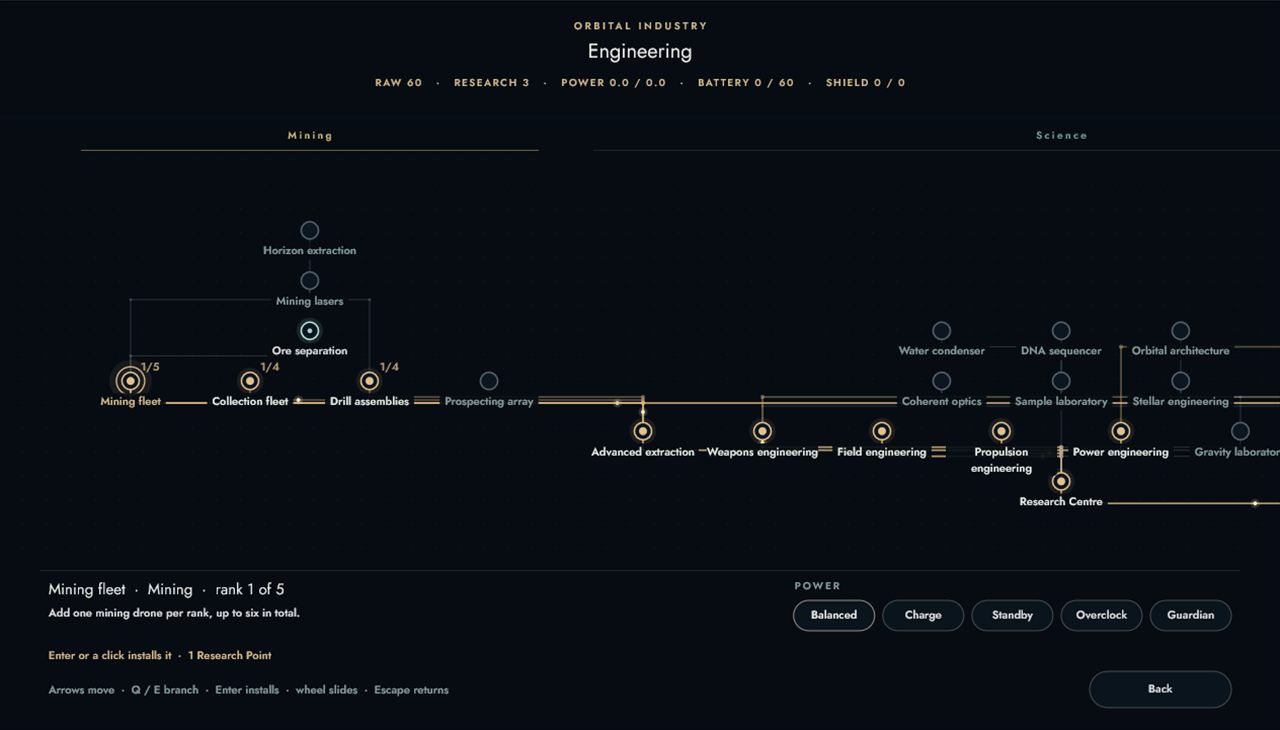
From moon scale, engineering turns your body into an industry. Press U for adaptations and K for the engineering trees. Every cost and prerequisite is shown, and every installation adds a visible module to your body or station.
The resources
- Adaptation points: one at halfway and one at the end of every evolution bar, plus goals, challenges and encounters.
- Raw Material: mined from real rocks. Shots and mining fracture mass into debris you can recover; ore does not regenerate by breaking it again.
- Research Points: made by the Research Centre from Raw Material.
The five branches
- Mining starts free. Install the Orbital Outpost for a station and one drone. Drones fly to intact rocks, cut them apart and carry the Raw Material home.
- Science: spend 25 Raw Material to build the Research Centre. Each powered batch uses 50 Raw Material and returns one Research Point after 18 simulated seconds. Science unlocks the other branches.
- Attack builds turrets that target rivals first and otherwise break up ore-bearing rocks. Optics and two turret ranks unlock lasers.
- Defense adds shielding and damage reduction.
- Speed adds thrusters, counter-thrust, braking and the Space boost.
Energy
Build closed-cycle turbines, fission reactors, fusion reactors, stellar collectors and Dyson swarms, in that order. Batteries store surplus power. Charge mode diverts power from mining, research, weapons and shields to fill them, and Fleet Overclock spends stored power to speed up all your equipment at once, up to 2.5 times for short bursts. Flight itself gains at most 25%.
A Dyson swarm is a real idea: a cloud of collectors orbiting a star to catch its light, first described by the physicist Freeman Dyson in 1960.