
Stellar-origin black hole
“A dark horizon surrounded by luminous matter.”
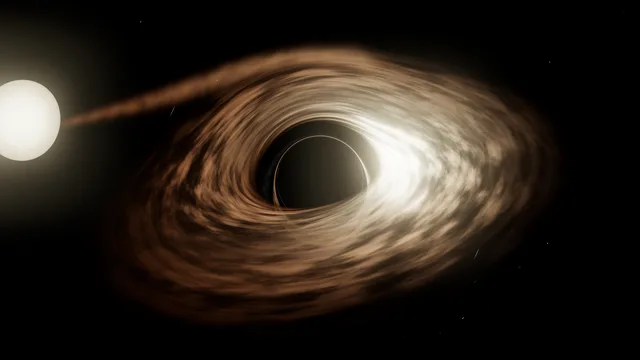
- Mass in the game
- 3.98 × 1032 kg, 200 solar masses
- Class
- 16 of 22
- To reach the next class
- Five times this mass, in game units
The real astronomy
When a massive star's core collapses, it can leave a black hole: a region where gravity is so strong that nothing, not even light, escapes from inside its event horizon. Cygnus X-1, studied since the 1970s, was one of the first objects widely accepted as a black hole.
In 2015 the LIGO detectors recorded gravitational waves for the first time, from two black holes of about 36 and 29 solar masses merging more than a billion light-years away. Detectors have since heard many more such mergers.
Black holes left by collapsing stars typically hold a few to a few tens of solar masses; gravitational-wave detectors have heard many of them merge.
From the in-game Field Guide
In the game
Black holes collect matter in a disk before gradually accreting it, and stored matter brightens the disk and drives jets. Each black-hole class in the game has its own look: this one has ember lanes.
Anti-Horizon is inspired by astronomy and simplified for play: sizes, times, distances and mass ratios are compressed. The sources page lists the science behind it.