
Growing asteroid
“A rubble pile begins to hold together.”
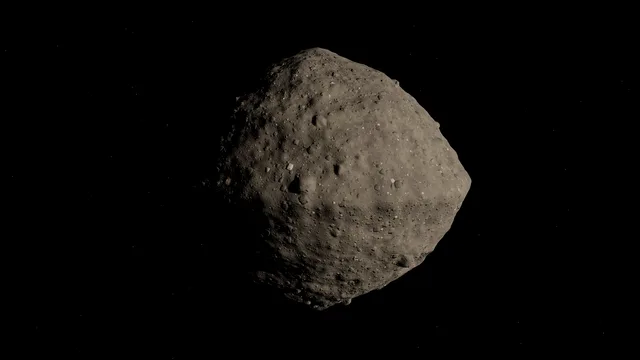
- Mass in the game
- 1010 kg
- Class
- 2 of 22
- To reach the next class
- Five times this mass, in game units
The real astronomy
At ten billion kilograms an asteroid is roughly two hundred metres across. Bodies of this size are often not solid rock at all but rubble piles: loose collections of boulders, gravel and dust held together by their own feeble gravity.
Two spacecraft have brought samples home from rubble piles. Japan's Hayabusa2 returned grains from Ryugu in 2020, and NASA's OSIRIS-REx delivered material from Bennu in 2023. When OSIRIS-REx touched Bennu's surface, its sampling head sank in as if the ground were a pit of plastic balls.
Many asteroids are loose rubble piles bound by weak gravity, like Bennu and Ryugu, both visited and sampled by spacecraft.
From the in-game Field Guide
In the game
Your pull reaches further now. Captured rocks spiral in before they merge, so slow, curving passes gather more than charging straight at a target. Each class needs five times the mass of the one before, so the climb speeds up as your reach grows.
Anti-Horizon is inspired by astronomy and simplified for play: sizes, times, distances and mass ratios are compressed. The sources page lists the science behind it.