
Dwarf planet
“Stone settles into a world.”
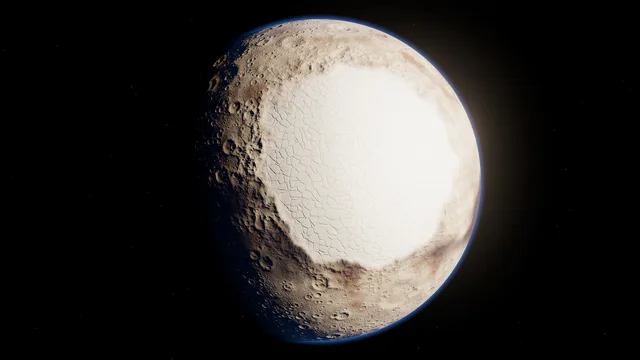
- Mass in the game
- 9.38 × 10²⁰ kg
- Class
- 4 of 22
- To reach the next class
- Five times this mass, in game units
The real astronomy
The game sets this class at the mass of Ceres, the largest object in the asteroid belt, about 940 kilometres across. NASA's Dawn spacecraft orbited Ceres from 2015 to 2018 and found bright patches of salt in Occator crater, left behind by briny water from below the surface.
In 2006 the International Astronomical Union defined a planet as a body that orbits the Sun, is massive enough to be round, and has cleared its neighbourhood of other material. Ceres, Pluto and a handful of others meet the first two tests but not the third, so they are called dwarf planets.
Dwarf planets such as Ceres and Pluto are round but have not cleared their orbits of other debris.
From the in-game Field Guide
In the game
You are round now, and the game draws you with relief and a real surface. Captures come faster as your gravity reaches further across the field, and rival worlds start to notice you.
Anti-Horizon is inspired by astronomy and simplified for play: sizes, times, distances and mass ratios are compressed. The sources page lists the science behind it.